
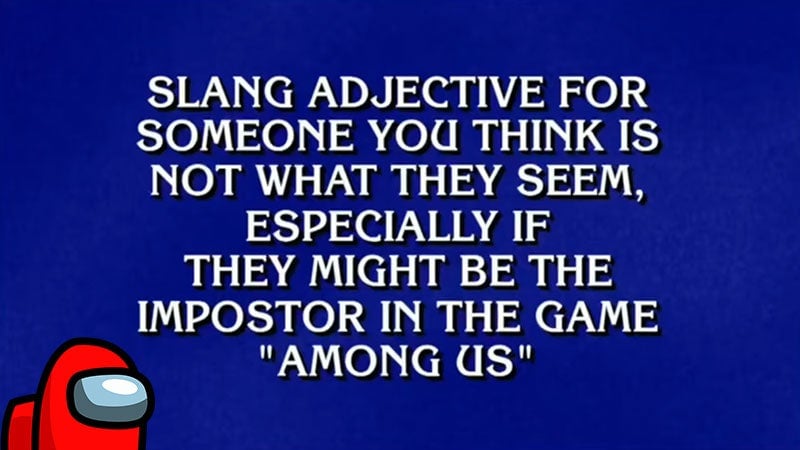
Among Us didn’t invent the word, I know, but it’s certainly responsible for its explosion in popularity over the last few years. So it shouldn’t be too surprising to see “sus” finally make it onto the game show, Jeopardy
In tonight’s episode, contestants were given the prompt, “Slang adjective for someone you think is not what they seem, especially if they might be the imposter in the game ‘Among Us.’”
Mattea nailed it:
Like I said, Among Us didn’t invent the word. Its recorded history goes back almost a century, when it was used in Britain as “police jargon.” To say someone was “sus” was simply…shortening the word “suspect,” the exact same meaning used today (and in the game).
While the word has some troublesome connotations—it was used in connection with some stop-and-search police search laws in the UK which turned out to be enormously racist—it has remained in constant use since, along with its sibling “to suss something out,” which living in Australia I still hear all the time.
Of course, my Dad and his mates using the word wouldn’t explain its wider adoption by internet culture, otherwise we’d all also be saying, “You’ve got Buckley’s chance,” or when you fall off something you’ve “come a cropper.” The use of “sus” as popularised in the last 20 years comes instead from its adoption by black communities online:
Since sus predates the internet, there’s no record of its first use online. But Multiple archived sources state that Black internet communities initially began using the slang on social media sites and forums.
The earliest Urban Dictionary definition was posted in August 2003 by a user named Diego who defined the term as simply, “Short for ‘suspect’ or suspicious.’” Since then, sus became a common American turn of phrase that was more widely used to describe anything that makes someone raise their eyebrow.
This would now be the part of the blog where I’d ask you to suggest the next “gamer” word that should appear on the show, but we would all die of embarrassment writing and/or reading them, so maybe we’ll just pass.