
The Last of Us Part II came out at the worst possible time. In June 2020, the pandemic was steadily becoming more terrifying, New York was under a curfew, and almost everything was closed or boarded up. The streets were all but empty despite the summer sunshine. I didn’t realize how good a job I’d done of forgetting that time, but as I made my way through Seattle again, it all came roaring back. That gnawing feeling of desperately wanting to catch a plane home, balanced against what then seemed like a pretty significant chance of Catching It and killing my parents. Rueing and lamenting every cigarette and joint I’d ever smoked. Drinking fancy wine alone—when would there ever be anything to celebrate again?—and staring out the window at the dying city below.
If you’re new to the series with the HBO TV show, a TLOU superfan, or missed the sequel on PS4 back in 2020, The Last of Us Part II Remastered is a fantastic chance to experience a truly superlative game—wonderfully free from the godawful context of when the game first came out. The remaster is a visually enhanced edition of the PS4 original, which also includes the roguelike No Return game mode, as well as a host of extras like a director’s commentary and scrapped sequences.
But, for better or worse, it can be hard to separate a game from the headspace in which you first played it. Like many people who love games, I often come to them for comfort and distraction. Persona 3 Portable remains a cherished favorite because it allowed me to drag myself, little by little, out of one of the worst times in my life. I don’t feel the same way about The Last of Us Part II, even though I know, objectively, that it is a masterwork of design artistry and storytelling. It is an exceptional work of art, and its cutting-edge accessibility innovations make the game so easy to enjoy however you like. But, as far as the story goes, it’s a little too soon for me. The second time around, the narrative of Part II remains a deeply upsetting experience that, as it turns out, I wasn’t quite ready to revisit yet.
Endure and survive
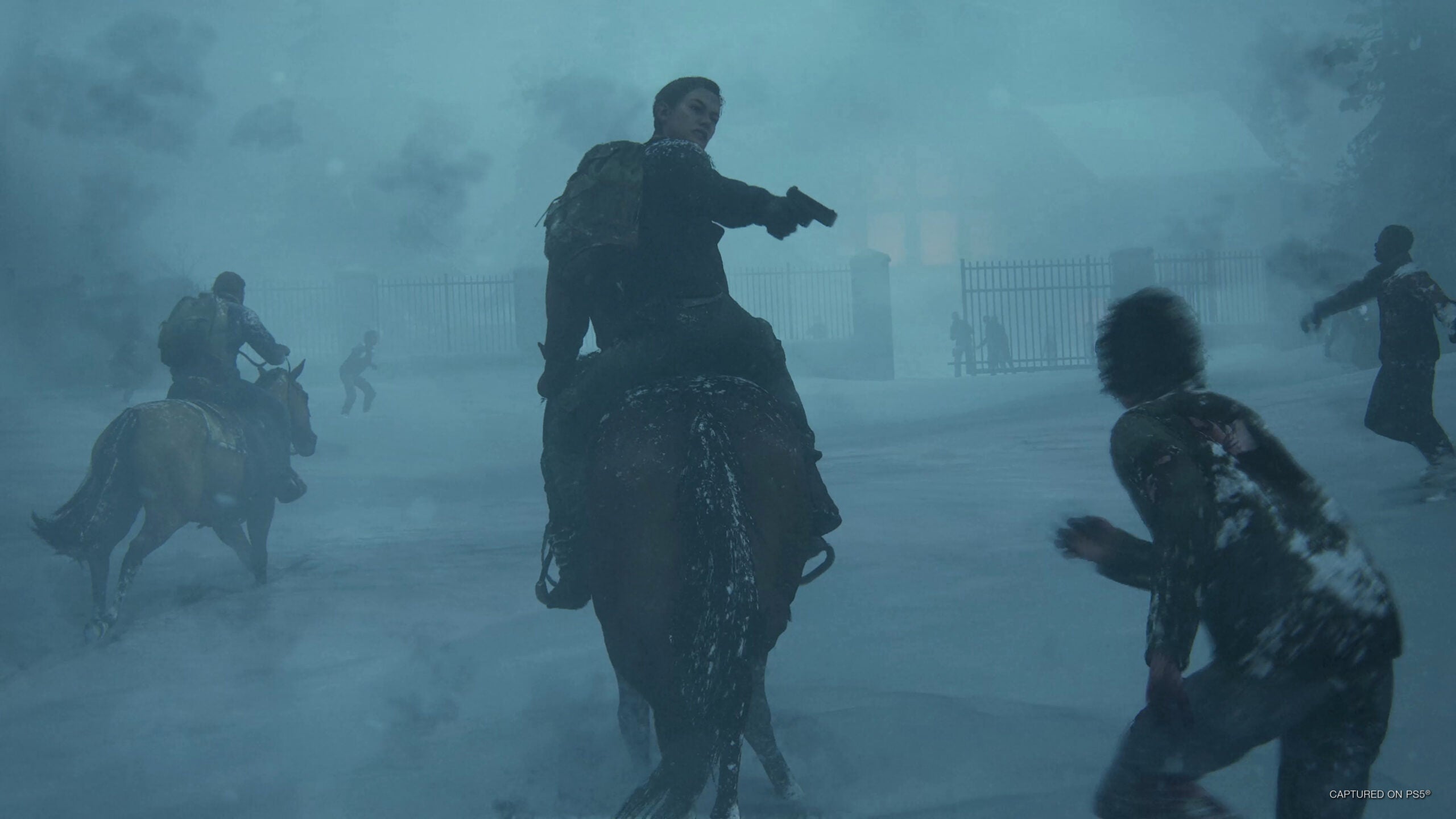
Part II takes place five years after the first game, and we find Joel and Ellie back where we left them, in the survivors’ enclave of Jackson, Wyoming. And it’s pretty bucolic, as far as post-apocalypse scenarios go. They’ve got a movie theater and a daycare center. People are falling in and out of love. And teenaged girls are bristling with resentment against their (adoptive) fathers. But we’ve got a video game to get to, so the tranquility doesn’t last long. Due to spoilery reasons I won’t divulge here, we join Ellie on a bloody journey to Seattle. There, she crosses paths with Abby, a member of the Washington Liberation Front, which is struggling to protect the Emerald City’s survivors from the incursions of a religious cult. As in the previous game, humanity’s conflict with the fungal-zombie Infected quickly takes a backseat to humanity’s conflict with itself. Discovering the extent to which Ellie and Abby’s actions affect one another—and finding the common ground between them—is one of the game’s great joys.
Gameplay in The Last of Us and its sequel consists largely of three elements: stealth-forward gun combat, exploration and scavenging for supplies, and occasionally solving traversal-related puzzles. Like its predecessor, Part II rewards you for looking around. Most pertinently, this is how you get more ammo and crafting supplies. It’s also an essential element of worldbuilding. Items and optional encounters in The Last of Us almost always tell a larger story, even if all the elements don’t fit together right away.
Early in the game, you’ll explore the suburban Seattle neighborhood of Hillcrest. Once you clear out the Infected, there’s a small garage that’s optional to explore, and when you open the door, you’re swarmed by four or five runners, presumably right after you’ve exhausted most of your ammo. Later, you’ll find a kid’s drawing of their dad Boris, the “archery champion.” A couple houses down, you discover a letter from Boris, explaining how he dragged his old friend into a “spored garage.” He continues, “I shut him in there… but he bit me. Those traitors are going to watch each other turn. They will suffer. I hope they think of me when they lose their minds.”
Shortly after, you encounter Zombie Boris, now trapped in his own garage. You blow a hole in his head and take his bow for yourself. There are missable moments like this all over Part II, and Naughty Dog has an unparalleled talent for fleshing out a world without big snoozy loredumps.
Beautiful disaster
Visually, The Last of Us Part II Remastered is an uptick from the base PS4 version I played in 2020, if a pretty minor one. Having spent a lot of time with the Yakuza series lately, I was surprised to notice that the finer details on Part II’s faces and clothing felt a little lacking. On RGG Studio’s goons, you can see individual pores and imperfections, and individual threads of fabric textures on shirts and suits. Granted, that series gives greater attention to flash and extravagance, but I was surprised to have even a small quibble to make about anything in a Naughty Dog remaster.
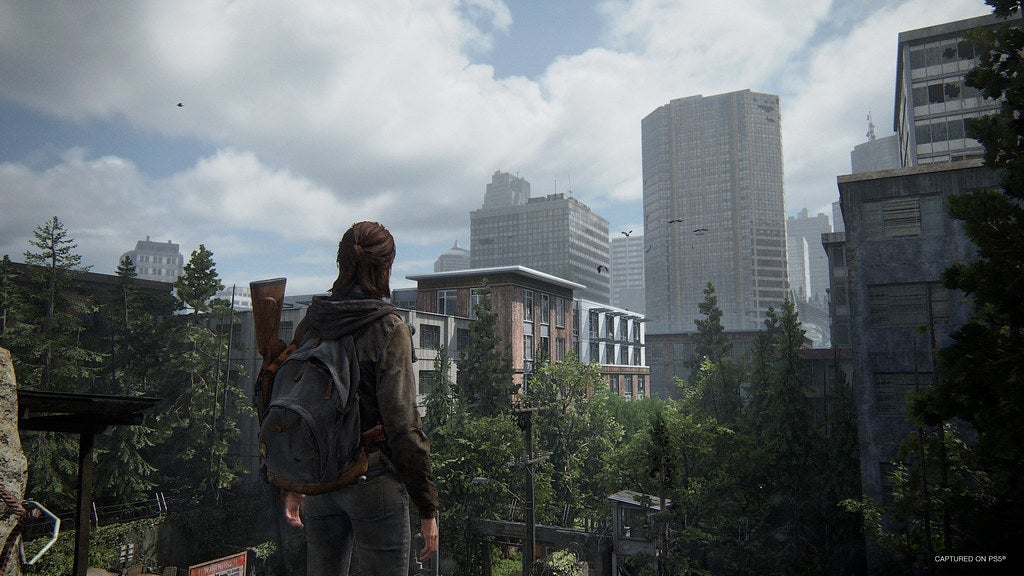
That said, the environments are truly a wonder to behold. The wild, overgrown hills of Seattle, with its low-lying pockets of fog dappled between the trees, are the stuff Pacific Northwest dreams are made of. (Has rain-sodden stone and brick ever looked this inviting?) And as much as the game’s Santa Barbara sequence is tough to stomach, I desperately hope the inevitable Part III is set in California, because every note is immaculate, from the spindly, hay-like weeds to the ranch houses to the sorbet skies.
Aesthetics aside, the meat of The Last of Us is in its combat, which is outstanding. As Ellie, you’re less tanky than Joel was in Part I, but you’re able to go prone to be more sneaky. If you get discovered and attacked, you can even fire a gun from on your back, which comes in handy more times than you might prefer. As someone who isn’t generally a huge fan of “stealth games,” the combat in Part II feels so dynamic that even doing the same fight twice rarely feels the same. There are so many hidey-holes for Ellie to explore, so many places to scamper away from the fray and get the jump on baddies, that it totally eliminates the pattern-memorization grind you’ll find in lesser entries in the genre.
That freedom to handle a given situation however you choose can feel dramatically at odds with the story Part II is trying to tell. As Ellie, you will beat a woman to death as she cries for mercy. You will kill dogs. You will end someone’s life as a nearby friend howls their name in agony, over and over again. Sometimes, you will not care. But other times, you will. You will not want to do the awful thing, and yet you must. This is where revisiting this game became difficult for me.
In Part I, we have 20 years of unspecified Dark Shit to keep us at some remove from Joel. We don’t know everything he had seen or done, but we know a lot of it was bad. That’s part of what makes the hospital sequence at the end of that game—and the first season of the HBO series—so memorable. There’s a part of him that we as players are not privy to. But to some extent, Ellie is “us” in a way Joel and Abby never are. We’ve seen so much more of her journey over two games, so we feel a greater sense of ownership about her actions. I enjoyed Abby’s sections a lot for precisely this reason—it was a relief to leave Ellie’s baggage behind.
The Last of Us Part II Remastered is the best way to play this truly excellent game, with sky-high stakes, stunning visuals, rewarding exploration, and phenomenally varied and thrilling combat. But to get the most out of it, you’ll probably need to have a stronger stomach than I do.


